Common App 2026-2027: What You Should Know About This Year’s Changes
If you’ve been through the Common App before — with an older child or as a counselor — you already know the drill: Every August, the application resets and a new cycle begins. The good news for the 2026-2027 cycle? Common App kept it relatively quiet this year. No major overhauls (they took care of that last year), no sweeping new sections. Just a handful of small but meaningful updates worth knowing before you or your student dives in.
Here’s what’s changing, what’s staying the same, and what you need to do (or not do) right now.
The Numbers First
Common App continues to grow. This past cycle, 1.5 million applicants submitted nearly 11 million applications across close to 1,100 member colleges. Nearly 100,000 counselors submitted over 30 million forms, which is up more than 3 million from the year before.
That’s a lot of paperwork, to say the least.
The takeaway for families: College admissions is competitive and increasingly global. Having a plan matters more than ever.
What’s Actually Changing
Activities Section Gets a New Name (and a Few Updates)
The Activities section is now officially called Activities and Experiences — a small but meaningful shift. The new name reflects what Common App has been saying for years: your student doesn’t have to be a club president to have something worth sharing.
A few updates that come with the rename:
- The position/leadership field is now optional. Students who’ve spent time on family responsibilities, hobbies, or informal work no longer have to leave it blank or make up a title.
- Categories have been updated to better reflect real life. “Work (paid)” becomes “Employment or work (paid).” “Junior ROTC” becomes “ROTC and Military.” Activities after high school graduation now have dedicated fields for time commitment.
- Instructional language throughout the section has been made more welcoming to students who don’t fit the traditional mold.
Here’s one thing that hasn’t changed: character limits. You still have just 100 characters to describe the organization and 150 characters to describe your involvement.
Once you've finished the section, preview your PDF to see how your entries read as a whole.
Independent Learners Get More Support
Common App is making the application more accessible to independent learners (students who are 23 or older and meet the FAFSA definition of independence). These students will no longer be required to answer questions about parents or siblings. They can indicate household composition if they choose, and a new question captures first-generation status for this group.
Fee Waiver Transparency
If you qualify for a Common App fee waiver, you’ll now see clearly which schools accept it — right on the college information page. Schools that don’t accept it will direct students to either pay the fee or seek a school-specific waiver. No more guessing or surprises mid-application.
Citizenship Status Question Gets Clearer
The “U.S. resident status” option has been relabeled as “U.S. resident with other status” with a help icon for clarification. Students who indicate they were born in the United States and select this status will be prompted to reconsider — a fix for a question that was frequently misunderstood.
Testing Updates (Mostly for International Students)
- Duolingo scores will now reflect a single test date rather than the highest scores across sittings.
- TOEFL launched a new version with a 1-6 scale; students can report scores from either version.
- Pearson Test of English no longer includes enabling skills in the self-report.
- Three new AP subject tests added: Business with Personal Finance, Cybersecurity, and Networking.
Essay Prompts: No Changes
The seven personal statement prompts remain the same — and last year’s data is reassuring. The most-chosen prompt was the open-ended Topic of Your Choice at 28%, followed by the adversity prompt at 22%, personal growth at 20%, and background/identity/interest/talent at 18%.
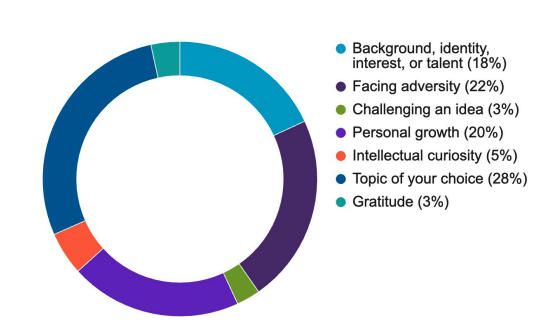
Which Common App essay prompts do students choose most? Topic of Your Choice leads at 28%. Source: Common App 2025-26 cycle data.
What does that tell us? No prompt has a clear edge. Colleges aren’t looking for a specific topic — they’re looking for a specific student. The right prompt is the one that gives you the most room to be yourself. If you’ve already been drafting, you're in great shape — nothing to adjust.
Account Rollover: What to Do Before Aug. 1
The first-year application closes on July 28 at 5 p.m. ET. The transfer application closes July 29 at 5 p.m. ET. The system reopens Aug. 1 with the new cycle.
What carries over: username and password, college list, answers to questions in My Common Application, and advisor invitations.
What does NOT carry over: responses to questions that have been edited or removed, direct admissions offers and scholarship matches, college-specific question responses, FERPA release authorization, and recommender invitations.
My advice: hold off on that last group entirely until after Aug. 1. There’s no point completing those steps twice.
For more details, check out Common App’s account rollover FAQ.
Need Support for Completing the Common App?
Feeling stuck on how to get started with the Common App? Check out my favorite resources to get you started and support you as you fill it out over the summer.
- AXS Companion — Open Resource. This is a free resource, and anyone can use or share it widely. No login or account is required, and no student data is collected or used. The AXS Companion includes about 50 modules, so students can use it for end-to-end assistance, or on an ad hoc basis to manage only those sections that are confusing to them.
- How to Fill Out the Common Application (2025) | COMPLETE Walkthrough (40-minute video from College Essay Guy)
- The Common App: A How-to Guide (College Essay Guy)
- How to Download and Preview Your Common App PDF. Once you finish your application, my blog walks you through saving or printing the PDF and what to check before you submit.
The Bottom Line for Students
This is a light year for changes — and that’s genuinely good news for all of us. You can focus on the work that actually matters: essays, activities, and making sure every section reflects who you really are.
If you're just getting started and you want expert guidance on the whole picture — essays, activities, the works — a 60-minute Power Hour session is a great way to get 60 minutes of personalized direction without a long-term commitment.
When you're done, download the PDF and read it slowly before you hit submit. Here's how.
And if you want to stay current as the new cycle unfolds, subscribe to my newsletter — I send practical, timely updates all season long so you’re never caught off guard.