Fast, Easy, and Free Ways to Proofread Your Essay
Last updated: September 2026
7 free ways to proofread your college essay — plus what to do (and never do) if you’re tempted to let AI edit it for you.
After you’ve put so much work into writing your essay, the last thing you want to do is submit it without checking it for spelling, punctuation, and grammar errors. An error-ridden essay can make your work look unprofessional — not the look you want, whether it’s for one of your classes or your college application.
While the writing process is essential, proofreading is what makes sure all that work actually lands. Here are seven free ways to do it — plus one thing worth addressing directly: whether AI belongs in this process at all.
1. Take a Brain Break
After you finish writing your essay, take a break from it. You’ve likely been reading and rereading your essay for hours, if not days or weeks, and you’re probably too close to it to read it with a clear brain right now.
Put it down. Really.
By stepping away from your work, ideally for a night or even for 30 minutes if you’re running up against a deadline, you can clear your mind and look at your writing with fresh eyes.
Yes, this means planning ahead and making sure you build enough time into your writing process to take that time away from the essay, but I promise it's worth it.
2. Run Spell-Check
You’d be surprised at how many people (students and professionals alike) don’t use this free tool for proofreading. Whether you’re using Google Docs or Microsoft Word, don’t forget to run spell-check. It’ll catch many errors (some you might not even realize are mistakes).
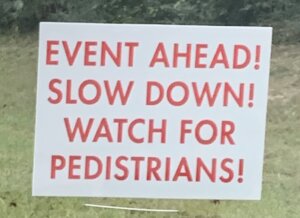
Spell check would've caught this!
But remember: While spell-check is a helpful tool, you can’t rely on it exclusively. Spell-check can miss errors (for example, it may not catch the misuse of their/they’re/there), so you’ll still want to review your work carefully to catch any mistakes spell-check might’ve missed.
3. Print Out Your Essay
When you proofread on a computer screen, you easily miss errors and skip over words. So why not go old-fashioned and print your paper out? Printing out your essay lets you review your work on paper, which makes your brain look at the essay differently — making it easier to spot mistakes.
4. Read Your Essay Out Loud
Reading your work out loud — either off the computer screen or off the printed page — can help you catch errors you might miss when reading silently. This technique is especially useful for identifying awkward phrasing or grammatical errors.
Pro Tip: Use the Read Aloud feature in Microsoft Word to give this tip an added boost. There’s something about those computer-generated voices that help mistakes stand out like sore thumbs. I use this strategy every time I proofread a piece of work or before I approve a student’s essay.
5. Use Online Resources
Grammarly’s free version offers real-time suggestions on grammar, spelling, and punctuation — its browser extension flags errors as you write, so you can fix them on the spot.
A quick note, however, that Grammarly will also make suggestions based on conciseness and tone. Those are suggestions that you want to be more mindful of. Just because Grammarly suggests it doesn’t always mean it’s right or it’s your voice.
6. Get a Second Opinion
Another way to proofread an essay for free is to ask someone else — like a parent, friend, or teacher — to look it over. Because they’re not as close to the essay as you are, their fresh pair of eyes and unbiased perspective can help you identify errors you might’ve overlooked.
Pro Tip: When asking for feedback from other people, be clear about what kind of feedback you want. If you want them to only check for typos, tell them. If you want them to give you the whole enchilada of feedback, tell them. If you’re not clear about the type of feedback you want, you may not get what you need or you may get overwhelmed with the volume of feedback you receive.
7. Use My Free Checklist
My free Essay Editing Checklist walks through everything to check off before calling your essay done. I built it for admission essays, but it's useful for any piece of writing you want fully polished.
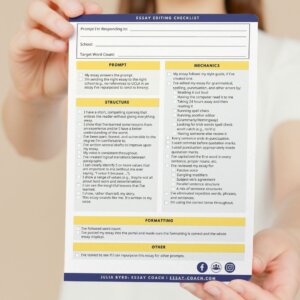
Get your free download of my essay editing checklist!
What About Letting AI Proofread It?
Here’s where I want to be direct with you: free grammar tools are fine. Having AI actually rewrite your essay is not — and it’s not just a coaching preference, it’s a real risk. When you submit your Common App, you’re certifying that “all information submitted in the admission process… is my own work, factually true, and honestly presented,” and a false certification can mean admission revocation, even after you’ve enrolled.
There’s a real difference between asking AI “what values do you see coming through in this essay?” and asking it to rewrite paragraphs for you. The first is feedback — in many ways no different from tip #6 above. The second is someone else’s writing wearing your name.
And practically speaking, it doesn’t even work in your favor: AI-edited essays come back flawless — perfect grammar, smooth sentences — and that’s exactly the tell. Admissions readers aren’t grading your grammar. They’re listening for an actual 17-year-old’s voice, and an AI-smoothed essay reads like nobody in particular. I can spot it within a paragraph. So can they.
Don’t Skip Out on Proofreading Your Essay
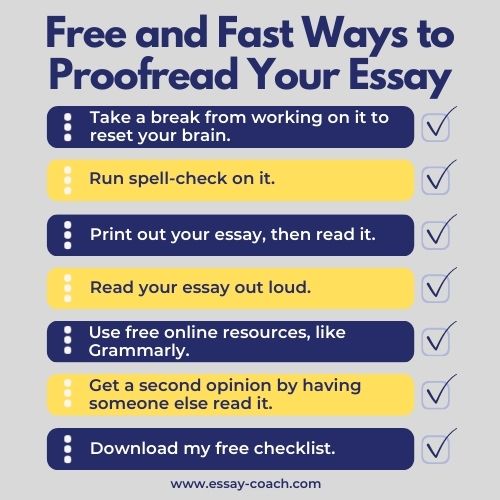
You’ve taken the time to write your essay — take the time to proofread it, too. Run through these seven free tips (skip the eighth), and you’ll submit something polished, professional, and unmistakably yours.
FAQ
How many people should proofread my essay?
One or two trusted readers is plenty (see tip #6) — more than that and you’ll get conflicting feedback with no way to sort out which notes actually matter.
Can I use ChatGPT to edit my college essay?
You can use it to ask questions about your draft — like what values or themes come through — but not to rewrite sentences or paragraphs. Common App’s certification requires the work to be your own, and admissions readers can often spot AI-smoothed prose.
What’s the difference between proofreading and editing?
Proofreading catches typos and grammar — everything above. Editing addresses whether the content, structure, and voice are actually working — that’s a different skill, and it usually needs someone trained to read essays the way admissions officers do.
Need More Help?
Sometimes you need more than what these free tools can give. If you’ve run through everything above and still aren’t sure the essay itself is working — not just the grammar — that’s exactly what a Personal Statement Review is for: a trained read on substance, not spelling. Or read more on Should I Hire a College Essay Reviewer?
Want to do the self-editing work yourself first? Grab my Self-Editing Your Admission Essay guide — it walks through how to evaluate your own draft before anyone else sees it. See also My Favorite Free and Low-Cost Admission Essay-Writing Resources.
Or if you’d rather just talk it through, contact me — I’d love to hear about your essay and how we might work together.